…Says From 36th to Top 5 Within 4 Years is a Tremendous Impact Which Osun People Will Never Forget in a Hurry
Politics is often about promises, but governance is ultimately about what people experience.
For 12 years, Osun State was governed by the All Progressives Congress (APC). Twelve years was enough time for the party to establish its legacy, implement its programmes and convince the people that its vision for the state was working.
When many residents look back at those years, the dominant memories are hardship, frustration and disappointment rather than the level of development they expected.
Available WAEC and NECO records show that the education sector during that period fluctuated significantly. Under Rauf Aregbesola (2010–2018), the administration inherited a 15.68 percent pass rate in 2010. The performance moved between 22nd position in 2014 and 29th in 2016, before peaking at 7th position nationally in 2018, which was the best result under the party. Under Gboyega Oyetola (2018–2022), the state recorded a sharp decline. According to the report of the Osun Education Summit Committee chaired by Prof. Oyesoji Aremu, Osun dropped to 14th in 2019, 34th in 2020, and 36th position in 2022. Some reports also ranked the state as 33rd and last in WAEC during that year, while a UNICEF report indicated that Osun led the Southwest in out-of-school children during the same period.
Today, less than four years into Governor Ademola Adeleke’s administration, there is a growing conversation about the direction of the state.
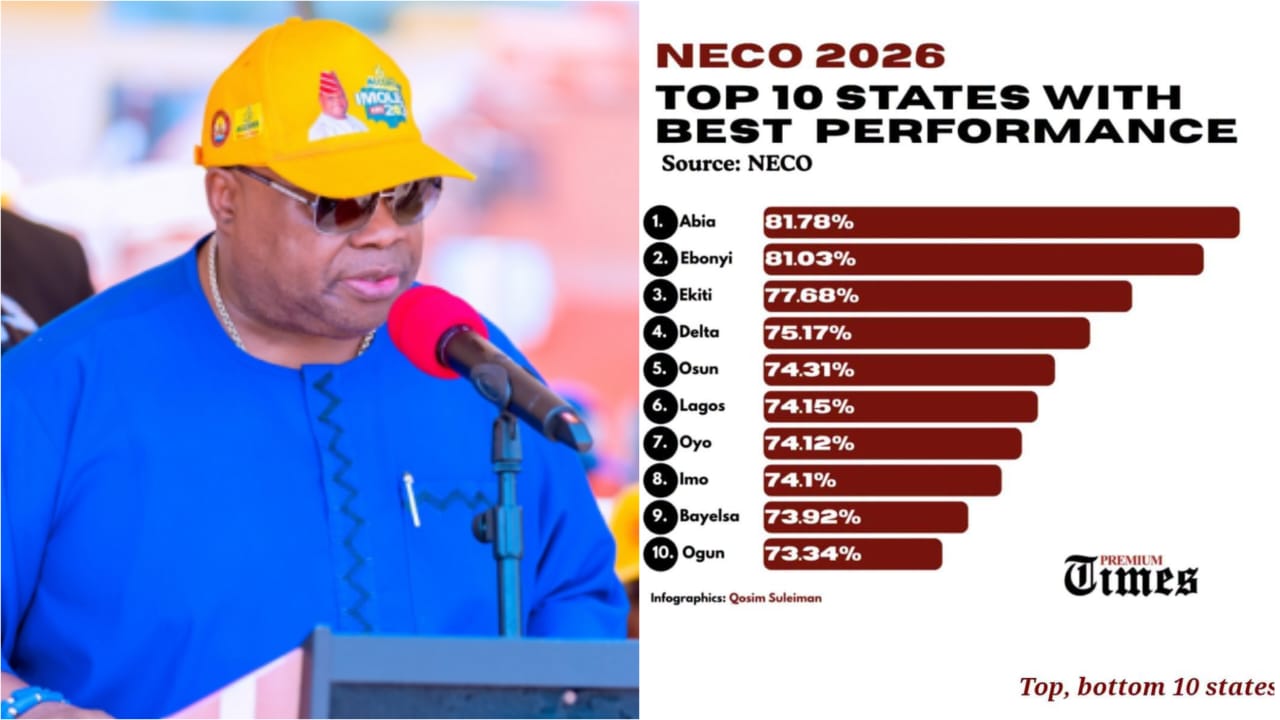
The latest NECO performance is one example. Osun has emerged among the top five performing states in the examination, with a reported 74.31 percent pass rate, improving from 7th position with 70.52 percent in 2024 to 5th in 2026. That achievement belongs primarily to the students, teachers and parents, but it also raises an important question about the attention being given to education. It marks a return to the top five after the decline recorded under the previous administration.
It is on this basis that I appreciate Governor Ademola Adeleke for his intensified efforts in education. His investment in school renovation, teacher welfare and learning infrastructure is a tremendous impact which Osun people will never forget in a hurry. It is indeed a blessing to have a governor like him in Osun State, and a model worthy of emulation by other states.
And education is only one part of the story. The Adeleke administration has also pursued interventions in infrastructure, healthcare, workers’ welfare, agriculture, water supply and empowerment. The state government has reported the rehabilitation of primary healthcare centres, renovation of schools, road projects and other interventions across the state.
Are all the problems of Osun solved? Absolutely not. Should Adeleke be praised for everything his administration does? No government should be beyond scrutiny. But should genuine progress be acknowledged when it occurs? Yes.
This is where the comparison with the previous 12 years becomes relevant. The argument is not that APC did absolutely nothing during its 12 years in government. There were projects and policies that its supporters can point to. But 12 years is a substantial period, and citizens are entitled to ask what those years ultimately delivered to their everyday lives. If people experienced prolonged hardship and felt that government was not adequately responding to their needs, that experience is part of the historical record as they understand it.
Osun residents should be allowed to compare both periods based on their lived experiences. That, perhaps, is the most important point. Adeleke’s administration should not be assessed merely because it belongs to a different political party. It should be assessed by what it does, what it delivers and how those actions affect ordinary people.
At the same time, the administration must understand that every achievement creates a responsibility to do more. A good NECO performance should lead to greater investment in education. Improved healthcare infrastructure should translate into better healthcare delivery. Infrastructure projects should be completed and maintained, and workers’ welfare must remain a priority.
The emerging picture is that Adeleke is using his relatively short time in office to pursue a different direction for Osun. Whether that direction ultimately produces the lasting transformation the people desire will depend on what happens in the years ahead.
But one thing is clear: 12 years of APC governance and less than four years of Adeleke’s administration provide Osun people with two different periods of governance to reflect upon. And when politics becomes about lived experience rather than slogans, the people themselves become the most important witnesses.
Osun people have seen the past. They are experiencing the present. History will record what each administration did with its opportunity to govern.
Signed:
Comrade James Onifade
Advocate for Good Governance and Judicial Reform